
From Neapolitan Roots to Lower Manhattan: The Enduring Legacy of Little Italy and San Gennaro

Abstract
This blog post traces the history, cultural legacy, and modern-day experience of New York City’s Little Italy, focusing on its iconic annual celebration: the Feast of San Gennaro. Beginning with the history of late 19th-century Italian immigration through Ellis Island to Lower Manhattan's Five Points district, the author explores how early settlers endured extreme hardship and built lasting communities. Though few Italian residents remain in the neighborhood today, their heritage endures through preserved local businesses, the Italian-American Museum, and cultural traditions. The post details the 1,700-year history of Saint Januarius (San Gennaro), the Neapolitan roots of his feast day, and its evolution into an 11-day, 10-block NYC festival celebrating its centennial anniversary. Concluding with a personal firsthand account of navigating the festival—highlighting vendor interviews, traditional foods, live entertainment, and local landmarks—the blog emphasizes Little Italy's role as a vital historic landmark honoring the sacrifices and lasting contributions of Italian-American immigrants.

Full Blog Post
Little Italy is alive and well in New York City! While not many Italians live in this neighborhood anymore, the stretch along Mulberry Street is still vibrant with Italian restaurants, stores and the annual San Gennaro Festival. When I think of Little Italy New York City, I think of the tens of thousands of Italians who settled here during their first stop in the United States following the departure of their beloved families and friends in Italy. This is also where many Italians stayed, began their own families and worked in all types of industries that built the New York City we know today. This stretch in Lower Manhattan has significant historical significance not only for the city, but also for the United States.
A Little History of Little Italy NYC
In the late 19th century, immigrants from the areas of Naples, Calabria and Sicily arrived in New York City. They came because of the destitute and dangerous conditions in their homeland. So much poverty, disease, crime and natural disasters forced Italians - especially in Southern Italy - away from their families. They heeded the opportunities in “L’America,” who - at this time - was welcoming immigrants. Over 4 million Italian immigrants came to the United States between 1880 and 1920. Many came through New York Harbor to be processed at Ellis Island. Those who were fortunate enough to be cleared for entry at Ellis Island (many others were rejected), went to be with family and relatives who sponsored them. Many of these people resided in neighborhoods in New York City (such as East Harlem), Brooklyn and the other boroughs. For example, my grandfather and great-grandparents went to Staten Island and the Bronx. Another neighborhood was in Lower Manhattan.
Near what we now know as Little Italy, was the Five Points District that encompassed the areas of Worth and Baxter Streets. These were slums where many Italian, Irish, German and Chinese immigrants lived in extreme poverty and poor conditions. They also experienced discrimination and awful diseases. The neighborhood was famously portrayed in the movies Gangs of New York and Cabrini. Part of the neighborhood was called “Mulberry Bend,” which was considered the worst and poorest in the area. This is where many Italians ended up.
Italians started to establish insular institutions that resembled Naples. They spoke their native language and opened stores and other Italian-centric operations. In order to survive and succeed, they had to learn English and adapt to American customs. They did.
Eventually, immigration slowed down in the 1920s due to various laws that created barriers to the flow of immigration into the United States. During this period, approximately 10,000 Italian-Americans lived in this neighborhood of Lower Manhattan.
As time went on, the Italian immigrants who called this neighborhood home either passed away or moved, as did their descendants. Many moved to other parts of the city, Long Island, Connecticut, New Jersey and elsewhere in the country. According to this article, as of 2010, there were no more Italians living in Little Italy - Manhattan.
However, the traditions, nostaligia and legacy of those who made significant sacrifices and risks have been sustained over the years and up to the present day. Restaurants, cafés, shops, specialty stores and even an Italian-American Museum remain today as a testament to the people who made their American beginnings in this neighborhood, as well as the contributions they made to their families and city. Another aspect of this neighborhood that remained was the San Gennaro Festival.
Origins of the San Gennaro Festival
The Feast of San Gennaro (Saint Januarius) has over a 1,700 year history. The 4th century saint was the bishop of Benevento, Italy. Benevento is a city that is about 60km north of Naples and one that has ancient origins. Benevento was founded by a Greek named Diomedes, who fought in the Trojan War.
The emperor Trajan had an arch built and dedicated to him in Benevento. In addition, Benevento a city encompassed by the ancient Appian Way - a strategic road between Brindisi (on the Adriatic Sea) and Rome. It is said that Saints Peter and Paul (separately) travelled this road on their quest to bring Christendom to Rome. Benevento has a Roman Theatre, which was built in the 2nd century and fit about 10,000 spectators. It is also known for the Museo del Sannio, whose structure is the ancient Church of Santa Sofia.
San Gennaro lived in the 3rd century and was killed in the year 305 A.D. Gennaro was the bishop at the time of the brutal Christian persecutions during the reign of the Roman Emperor Diocletian. Not much is known about Gennaro’s life, but what is known is that he hid Christians from the Romans. On one occasion, he went to visit some deacons in prison. He was arrested and some accounts state that with the deacons, he was thrown to wild animals for a certain death. The animals remained calm around them, so the Romans beheaded the group of holy men, including Gennaro. Another account has the Romans changing their mind about throwing them to the wild animals to prevent a spectacle and instead they simply beheaded them.
What is most known about Gennaro occurred after his martyrdom. It is believed that his blood was preserved and brought to the Naples Cathedral, where it now sits in a glass reliquary. San Gennaro’s blood is associated with the safety and protection of the city from attacks and natural disasters - most notably the potential eruption of Mount Vesuvius. The miracle concerning his blood is that it liquifies in certain instances, such as on his feast day - September 19. The cardinal of the cathedral will take the reliquary and turn it upside down. The faithful believe that if his blood shows liquification in the reliquary, his intercession for their safety will be sustained. In recent history his blood did not liquify on a few occaisions. For example, it did not liquify in 1980 and there was a devastating earthquake. It also did not liquify in 2020 - which was the year that the COVID-19 pandemic occurred. Italy was one of the countries most significantly affected by the virus.
Each year in Naples on September 19, San Gennaro’s blood is processed around the city. There is also a festival in Naples with music and the iconic (and delicious) Neapolitan food.
History of the San Gennaro Festival in NYC
In 1926, the Neapolitan community brought their traditional feast of San Gennaro over and began celebrating it in 1926 as a one-day religious devotional feast and block party in honor of their patron. Over time, immigration to the United States from Italy slowed. Immigrants and their descendants began moving out of the city to the suburbs and throughout the country. The neighborhood changed, but the area around Mulberry Street remains New York City’s “Little Italy.” In addition, along with the many restaurants, stores, bakeries and delis along Mulberry Street, the pride and joy of Little Italy - the San Gennaro Festival - continues each year for an eleven day period.
This year, the Feast of San Gennaro in New York City celebrates its centennial anniversary. The festival started on Thursday, September 17 and concluded on Sunday, September 27, despite the arrival of a Nor’easter on the final weekend.
AOTA Experience
I arrived at the San Gennaro Festival on the evening of Thursday, September 24. Originally, I had planned to attend on Saturday, September 26 for the procession of San Gennaro, but Mother Nature had a Nor’easter in mind for that day. While the festival went on, I’m glad I did not wait because I would have never made it out of my flooded town of Sea Bright, NJ.
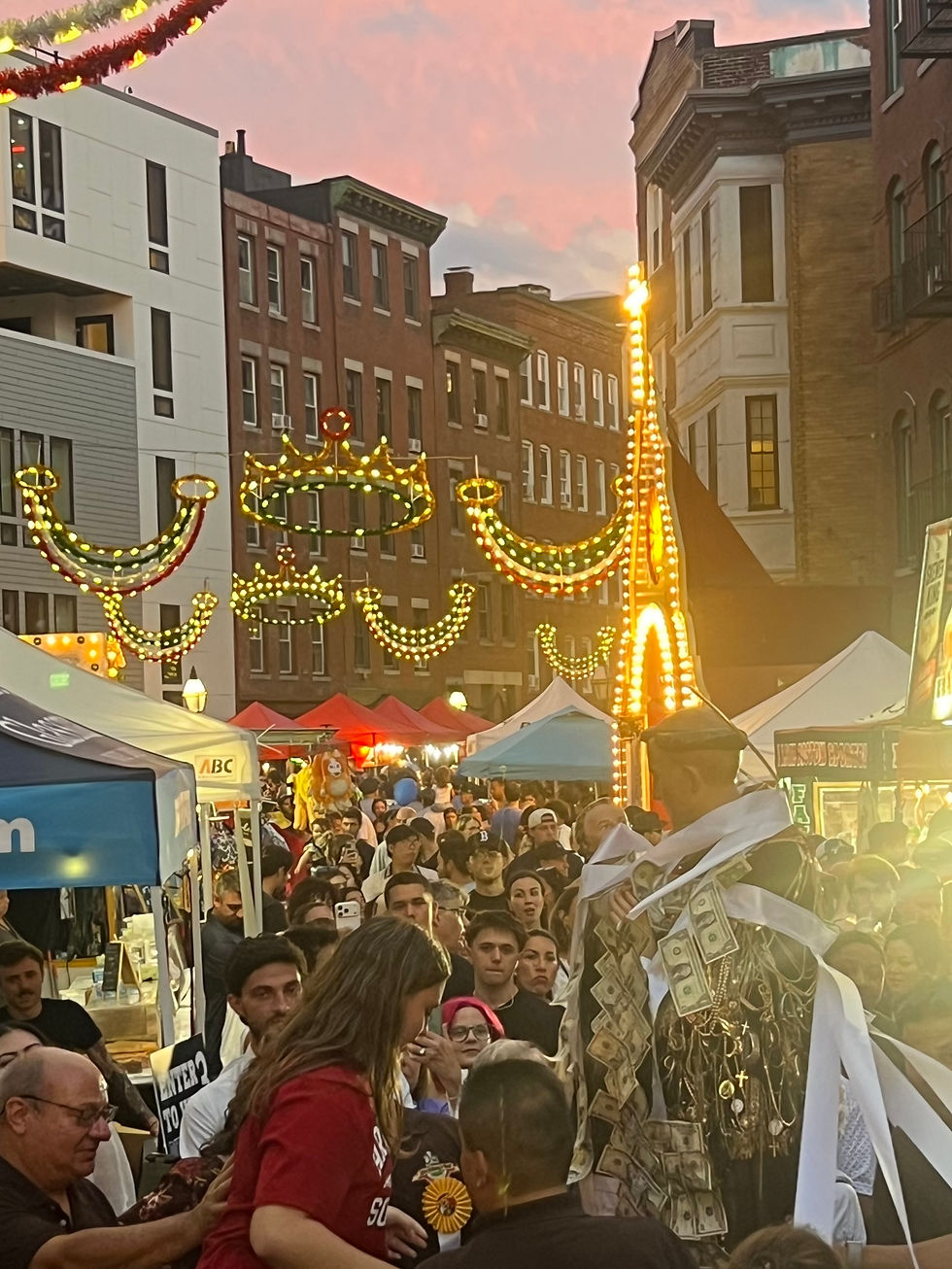
Let me begin by saying, this festival is enormous. It stretches 10 blocks, or about a half mile between East Houston and Canal Streets. There are even a few side streets closed off for rides, games, a concert stage and food vendors - such as Hester and Grand Streets. At the end of the day, it is New York City and anything in this city is on another level.
For a Thursday night, I thought the feast was well attended. This is an eleven day feast where the planning starts in January and the workdays go from 12 to 15 hours, according to Gino, a Figli di San Gennaro committeeperson. (You can see my interview with Gino on my Facebook and Instagram sites.)
I walked the entire stretch of the feast - up and down Mulberry Street. While walking north toward Houston Street, there was a clear vision of the Empire State Building as if it were right in front of me. I could not help but picture myself in the years 1930 and 1931 - in the midst of the Great Depression - as that iconic building was being constructed. I thought about what it must have felt like for an Italian immigrant, or their child, to watch the Empire State Building take shape and finally touch the sky—a rising symbol of hope during a challenging era.
As I walked the feast, I observed that the vast majority of food vendors are Italian-centric, there are some other nationalities represented. The famous Ferrara’s Bakery on Grand Street had an amazing display. Nearby the bakery is the San Gennaro Festival Stage where daily musicians and bands perform. I happened to come upon Lisa Messina, Angelo Venuto and John Micalizzi who were performing my favorite Italian and American contemporary music. The crowd was into it, dancing and having a blast. Along my walk, there were also amateur performers, such as a solo linguist singing Italian music and a young gentleman playing the accordion.
The food is endless. Several sausage and peppers, zeppole, cannoli, gelato, rice balls, gnocchi, mozzarella and other food stands. The famous Lucy’s Italian Sausage is well represented. I even made some new friends who run La Dolce Fresca gelato and Gnocchi on the Go - by the Gnocchi King of NYC (check out my interviews with them on FB or IG). They will both be at the upcoming Mount Loretto Italian Festival on Staten Island on October 9-12.
Toward the north end of the festival, there seems to be less Italian food and more food of other ethnicities. There are also more retail tents. The festival pretty much ends right past the Old Saint Patrick’s Cathedral, which is the historic church of many Italian immigrants who lived in this area. Unfortunately, when I reached this point, the cathedral was closed. I have not yet been inside and understand it is a beautiful church, so I will make it a point to get there soon.
The final observation that I want to make about my walk along Mulberry Street is something that is vastly different from most other feasts I have attended. In addition to the many food vendors (mostly trucks and trailers), there are several Italian restaurants and cafes that line Mulberry Street. These restaurants and cafes set up covered outdoor seating and provide menus just for the feast. If you’re not into feast food, having a sit-down meal while simultaneously enjoying the festival is definitely an available alternative.
Because I am watching my diet these days (taking some time off from the sausage and pepper sandwiches and cannoli), I sat down at a nice restaurant called Lunella (173 Mulberry Street). I had delicious grilled salmon, asparagus and a nice glass of Chianti. After my visit with Vinny from La Dolce Fresca, I did break from my diet and indulged in his decadent Rich Pistacchio gelato.
AOTA Takeaway
This was not my first time at the San Gennaro Festival. I had gone once at night several years ago. When I worked in TriBeCa, during the feast, I would also walk over at lunchtime to grab a sausage and pepper sandwich.
It goes without saying that my observation of festival goers at the San Gennaro Festival was that they were having a blast. This is definitely an event and an experience that people inside and outside of New York City look forward to. The vendors and restaurants are also very dedicated and work long and busy hours to provide for the thousands of daily festival goers.
While different from other feasts I’ve attended this year for reasons such as size and just being in New York City, there is a strong devotion within the organizers to keep this feast going. The feast is a staple and tradition of a very historic and storied Little Italy - Lower Manhattan. In my discussion with Gino (see the interview on my FB and IG pages), the Figli di San Gennaro Committee plans most of the year and works very long hours to make this feast happen. For many years, the feast has been and continues to be a huge success. It is definitive of the legacy that was started by Italian immigrants who worked to build the beautiful skyline that we see today. It is also a testament to the many immigrants and their descendants that faced all kinds of odds and adversity to make new beginnings in the United States and become the successful ethnic group that they are today.
New York City’s Little Italy is a world-renowned historic landmark that must be preserved. It honors the memory and legacy of the immigrants who helped build and sustain this nation. As an aside, I highly recommend that you watch the movie Cabrini. You will get a sense of the plight of Italian immigrants who came to New York City in the late 19th and early 20th centuries.
I also encourage you to stay tuned for an upcoming documentary on the feast called The Streets of Little Italy: 100 Years of San Gennaro. It is currently in production and is being directed by Paul Borghese. It is set to be released in early 2027.
Viva San Gennaro!
Forza Napoli Sempre!
Buona Festa!

Comments